


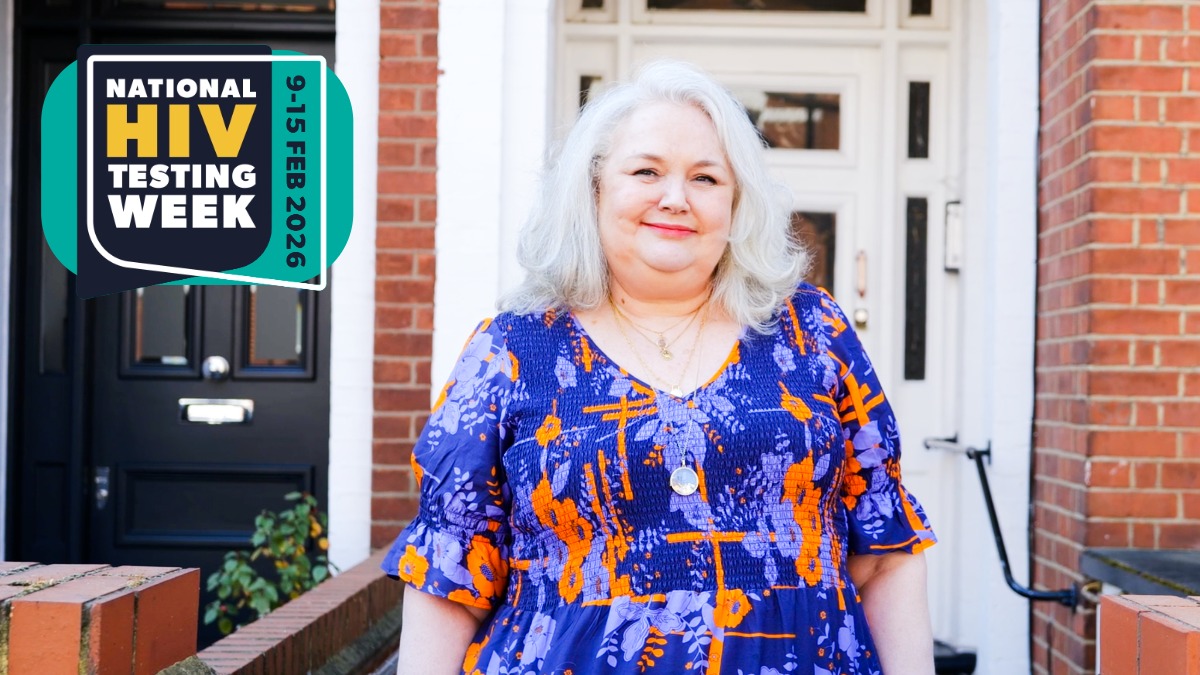
National HIV Testing Week highlights that knowing your HIV status is one of the most important steps you can take for your health – and for ending new HIV transmissions in London.
It is also a reminder that HIV testing should not be a one-off. Regular testing supports earlier diagnosis, improves health outcomes and helps prevent onward transmission. It must be a normal part of looking after our health – free from fear, shame or stigma.
Sara shares her story to highlight why testing can be life-changing.
Sara is 60 and lives in London. She is living with HIV and was diagnosed while being treated for another condition at St George’s Hospital. She found out only when her health had deteriorated and she was admitted to hospital in a critical condition.
Sara has ulcerative colitis, a long-term condition that she developed following a bout of food poisoning. When she attended the clinic for treatment, her health had been so seriously affected that she was immediately admitted to the hospital for life-saving treatment. As part of the admission process, Sara was tested for HIV and hepatitis.
Four days later, while still in hospital, Sara was told she had HIV:
“Initially I was in shock, I didn’t know how I was going to cope. I didn’t know if I was going to die. It was really distressing.”
Sara phoned her GP and asked for advice. Her GP reassured her that everything would be OK:
“When I spoke with my GP, she right away told me that I would be fine. Treatment is simple – it is just one pill a day – it’s a long-term condition that you can manage, it is nothing to be frightened of and it is not a death sentence.”
Sara had been experiencing health issues that were linked to having a weakened immune system. Having HIV now made a lot of sense:
“I was so ill when I was diagnosed. I’d had food poisoning when I was travelling but when I got back home I still wasn’t getting better. I had no reason to think I had HIV, I wouldn’t have gone for a test, it didn’t enter my mind. Even my GP said she never would have thought to give me an HIV test, but HIV is not selective, like all viruses, anyone can get it. If I hadn’t been tested in hospital that day, I don’t know what could have happened. It is frightening to think I might not have found out in time.”
Sara says she feels lucky she was tested for HIV before it could cause more damage.
“Even if you think there is no way you could have HIV, why not just be tested and be sure? It’s easily treated. It is just another long-term condition. It is better to know if you have HIV – with medication you can recover and you won’t pass it on, that’s really reassuring. The HIV clinic is excellent, nurses know you by name and are really kind and understanding too, you always see the same consultant. There is such a personal caring service all the way.”
For Sara, knowing the cause of her health issues was life-changing and she says there was a lot to learn about having HIV:
“If I knew what I know now when I was first diagnosed, it would have been so much easier. Getting tested and knowing is the first step. Once you get your head around it, your attitude towards it changes. It is a very personal thing to talk about but it is part of my life and I’m quite happy to admit I have HIV and help more people understand it.”
Sara was diagnosed prior to opt-out testing for blood borne viruses being adopted in emergency departments. She is optimistic about what it means:
“My immune system was terribly affected by the time I was diagnosed, I’d visited A&E, if I’d been tested then if I had found out sooner, it could have made a lot of difference. I don’t want other people to have to go through what I have. Not knowing is so much worse, once you know then you can do something about it. A&Es see a huge number of people, if they automatically test everyone they will find more people who need medication and support so they can live well with HIV and help stop it being passed on.”
Why routine HIV Testing Matters
Sara’s story shows why regular testing supports earlier diagnosis, improves health outcomes and helps prevent onward transmission. It must be a normal part of looking after our health – free from fear, shame or stigma.
HIV treatment today means people living with HIV can live long, healthy lives. Once on effective treatment and with an undetectable viral load, HIV cannot be passed on to sexual partners.
The earlier HIV is diagnosed, the better the health outcomes – and the greater the impact in preventing onward transmission.